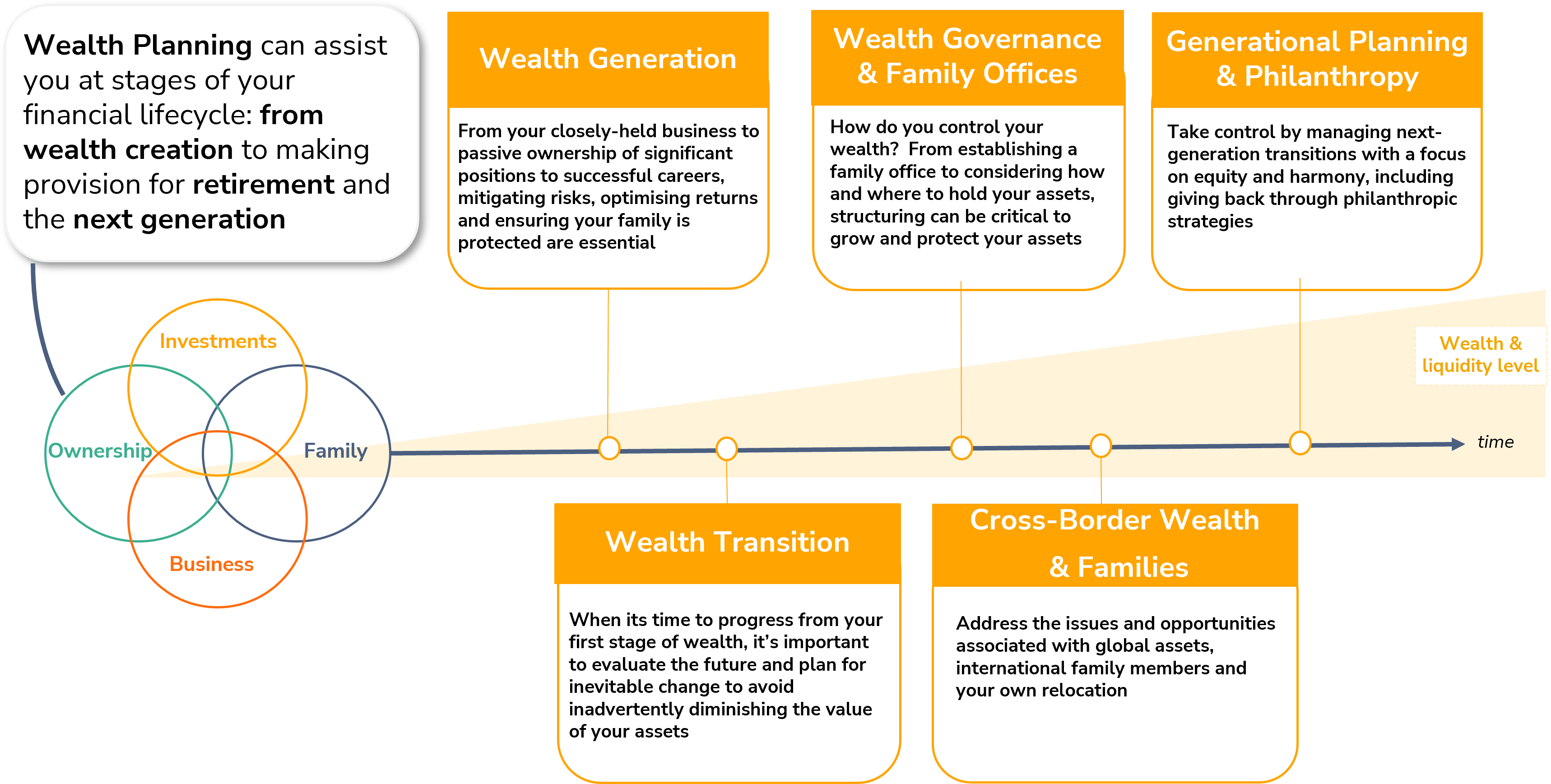
wealth planning

Wealth Generation

How can you grow your wealth while managing risk?

The priorities at this stage depend on how your wealth is created.

Entrepreneurs should focus on protecting business value through appropriate ownership structures, succession planning, shareholder agreements and insurance against key-person risks.

Investors should ensure their portfolios remain tax-efficient, adequately diversified and aligned with their objectives, taking into account all sources of wealth and exposure.

Professionals should protect their most valuable asset—their future earning capacity—through appropriate contingency planning for illness, disability, redundancy or premature death.

Ultimately, the goal is not simply to create wealth, but to preserve and grow it in a resilient manner.

Wealth Transition

How do you prepare your wealth for the next generation?

Once financial objectives have been achieved, the focus shifts from wealth creation to wealth transfer.

Are future generations prepared for the responsibilities of ownership? How can they be educated and involved in decision-making? What governance structures are needed to support a successful transition?

For business owners, this may include evaluating an eventual sale, IPO or merger while ensuring sufficient liquidity and financial independence for the family.

For those with real estate, art or other tangible assets, it is important to assess whether these holdings continue to support long-term objectives and how they can be transferred efficiently.

The objective is to ensure wealth remains a source of opportunity rather than complexity for future generations.

Wealth Governance & Family Offices

How do you effectively manage increasingly complex wealth?

As wealth grows, governance often becomes as important as investment performance.

Many families consider establishing a family office, but the appropriate model depends on factors such as:

  • Family involvement
  • Asset complexity
  • Governance requirements
  • Access to specialist talent
  • Cost and operational efficiency
  • Tax considerations
  • Long-term investment objectives

Equally important is determining how assets should be owned and controlled. Whether held directly, through companies, funds, insurance structures, trusts or foundations, the right structure can improve efficiency, enhance protection and simplify succession.

The goal is to create a governance framework that enables wealth to be managed, protected and transferred effectively across generations.

Cross-border Wealth & Families

How do you manage wealth across multiple jurisdictions?

Modern families are increasingly international, with family members, businesses and investments often spread across different countries. As a result, residence, citizenship, domicile and the location of assets can all have significant tax, succession and reporting implications.

Understanding how these jurisdictions interact is essential to protecting wealth, avoiding unintended consequences and ensuring assets can be transferred efficiently to future generations.

The goal is to create a coordinated strategy that optimises the growth, protection and transfer of wealth across borders.

Generational Planning & Philanthropy

How do you create a lasting legacy?

Effective wealth transfer is about more than tax efficiency. It involves ensuring assets pass to future generations in a fair, orderly and harmonious manner while protecting family relationships and respecting succession rules.

Key considerations include lifetime gifting, succession planning, the treatment of minors and vulnerable beneficiaries, and the efficient transfer of complex assets such as real estate and family businesses.

Philanthropy can also play an important role by creating a shared sense of purpose, helping future generations develop stewardship skills and enabling families to make a lasting contribution to society.  The goal is to ensure that wealth becomes a source of opportunity, values and legacy for generations to come.

You want to know more?