The Federal Reserve concluded its two-day meeting on Wednesday. Key takeaways are the following:
- The Fed will be buying $60 billion of bonds each month starting in January, half the level prior to the November taper and $30 billion less than it had been buying in December. The Fed was tapering by $15 billion a month by November, doubled that in December, and will accelerate the reduction further come 2022. This puts them on course to conclude asset purchases by March, from the prior landing zone of around June, although this could be adjusted if warranted. It should also be noted that the vote to speed up QE tapering was unanimous, so it seems the new vice chair Lael Brainard also cares about price stability.
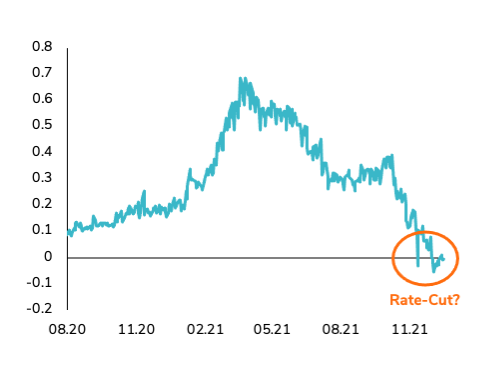
- After QE tapering wraps up, in late winter or early spring, the central bank expects to start raising interest rates, which were held steady at this week’s meeting. Its updated projections of future interest rate rises (aka, the “dots”) show a median three hikes next year, up from one shown in September. And while the last “dot plot” showed half of the 18 members ruling out hikes in 2022, all now agree that at least one will be needed. The longer-term, terminal rate view is unchanged, however.
- Inflation forecasts were revised up to 2.6% for headline PCE by the end of next year (2.2% previously), while the core measure is seen at 2.7% by end 2022 (vs. 2.3% before). The word “transitory” was retired;
- The Fed sees the economy continuing to grow. Its growth view for next year was revised up, although 2023’s pace was revised down a touch.
- On the labour market, the Fed sees the jobless rate return to the 3.5% mark next year (vs. 3.8% previously), where it is likely to stay over its forecast horizon.