Almost exactly 50 years ago, US President Nixon returned from a week-long diplomatic visit to China. The success was unequivocal: he had convinced his Chinese counterpart to move away from the Soviet orbit and help America spy on the USSR. Nixon was then re-elected. The stage was set for China's eventual integration into the world economy.
Today, the world has changed. China's role in the international system has taken on far greater proportions than Nixon had imagined. On the Chinese side, President Xi Jinping makes no secret of his view that America is a declining superpower that will do anything to block China's inexorable rise to global supremacy. Donald Trump had begun a decisive turnaround by imposing tariffs on Chinese products. Now President Biden, who has rallied Europe, Australia and Japan in his fight against autocracy and the promotion of democracy around the world, presents a more complex problem for Xi Jinping.
This rapprochement could prove to be one of the most important geopolitical developments in decades, in some ways the antithesis of what Nixon tried to achieve in the 1970s.
Russia and China are not natural allies and Chinese leaders have long argued for a world without formal military alliances, avoiding entanglement in other countries' military conflicts. However, Putin and Xi have many common interests. Both men were deeply shaken by the collapse of the Soviet Union. Both have cracked down hard on dissent or circumvented presidential term limits, which should allow them to remain in power indefinitely. But above all, they share the same vision - that of the end of American hegemony - while aspiring to restore their respective countries' role as super powers, with the ultimate goal of recovering territories they consider to have been lost:
Ukraine, in the case of Russia, and Taiwan, in the case of China.
A few hours before the opening night of the Winter Olympics in Beijing, a major event went almost unnoticed. Putin and Xi Ping issued an extraordinary joint declaration, promising that their cooperation would be "superior" to that forged between the two countries during the Cold War. This includes armaments and defense policy. China now supports Russia's demand to stop NATO enlargement. Russia supports China's claim to Taiwan.
But their joint statement is also a manifesto calling on the US to recognise that it is no longer the world's policeman. The world has changed, they say. Russia and China must be respected as 'global powers' that can dictate what happens in their own backyard.
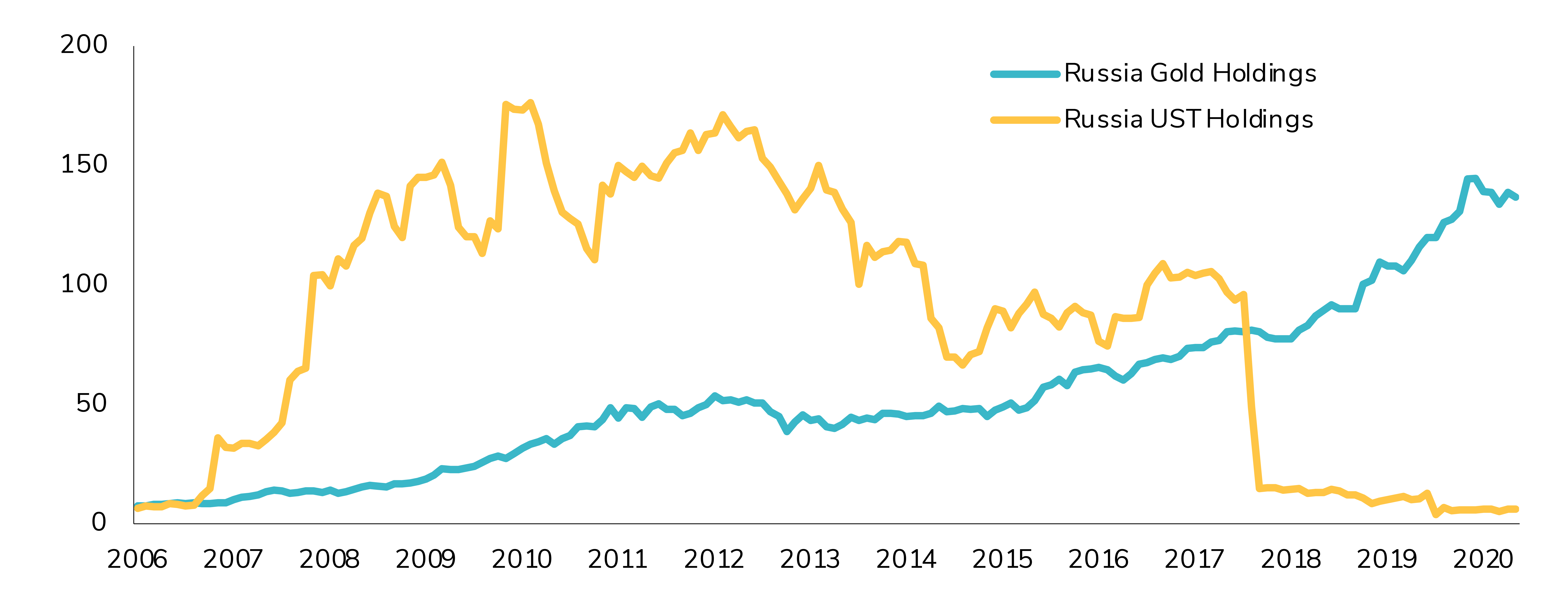
This confrontation with the Western world - and primarily the United States - is not just geopolitical. Indeed, the two allies of circumstance have engaged in an economic war with the US, through control of the global supply chain and energy prices. By accumulating gold and dumping US Treasuries, they are trying to strip the dollar of its status as a reserve currency.
As a reminder, the Bretton Woods monetary system was organised around the US dollar, linked to oil. More than a multilateral monetary system, Bretton Woods was a military, political, economic and energy domination of the United States. The end of the Bretton Woods system in the early 1970s did not change the situation. It even allowed the advent of the dollar standard, with the greenback replacing gold as a guarantee of stability and therefore as the world's primary reserve currency.
The fact that the dollar had this status meant that the United States did not have to build up foreign exchange reserves in the currencies of other countries, and above all that it could finance its balance of payments deficits thanks to its power of monetary creation. Indeed, the additional issuance of dollars makes it possible to finance the US debt at a lower cost, as US Treasury bonds are favored by other states to build up their reserves.
However, the US government abused its privilege, accumulating massive debts, creating rampant inflation as it exited the Covid-19 crisis and paying back its creditors in devalued dollars. At the same time, the dollar now faces a double challenge: first, the rise of the Chinese renminbi (RMB). But also the retreat of the United States on the global military stage.
Indeed, the US military is retreating, a trend that started under Trump and continuing under Biden with the withdrawal of troops from Afghanistan. Once the world's policeman, Biden's America has turned into a mere observer of the Russian invasion of Ukraine. This is a boon that Putin has obviously taken advantage of.
With a muted US military, is there still a need for the petrodollar reserve currency system? Moreover, given the continued depreciation of the real value of the greenback, why should trading partners continue to settle their transactions in dollars?
The Sino-Russian couple has perfectly seized this opportunity and has the capacity to exacerbate American weakness. Firstly, by contributing to inflationary pressures. In recent months, Joe Biden's popularity has plummeted, particularly as purchasing power has fallen due to a 40-year high in inflation. Although this inflation is fueled by ultra- expansionary fiscal and monetary policies, the behaviour of Russia and China plays an important role. Russia is one of the world's largest energy exporters and the escalation of the Ukrainian crisis in recent months has contributed to further tightening the energy market, putting additional pressure on inflation. On the other hand, China, as the world's factory, has played a key role in the slowdown of global supply chains during the Covid-19 crisis. China also has a propensity to hoard essential goods (notably agricultural commodities) through export restrictions, contributing to higher commodity prices. Russia and China are adding to inflationary pressures, a dynamic that weakens the Biden administration's ability to govern at home. When domestic conditions become more difficult, leaders generally have less leeway to act on foreign and military policy.
Another dynamic that is unfavourable to the United States is the fact that global commodity transactions are less and less denominated in US dollars. This is largely driven by China, which is steadily moving towards settling its commodity transactions - particularly oil - in RMB or gold. This trend has been in place for several years and the Sino-Russian alliance only reinforces it.
This has a major consequence for the US: as the dollar is used less and less in trade, it becomes less necessary for foreign countries to hold treasury bills in reserve. In the long run, this new paradigm could increase the borrowing costs for the US government and de facto reduce Uncle Sam's ability to finance his armament programmes. A context that would leave the field open to Russian and Chinese dreams of territorial (re)conquest.
The Russians and Chinese are even in a position to accelerate the rise in US debt yields and to reinforce the attractiveness of gold by using their very large foreign currency reserves. For example, the yellow line, which represents the amounts held in US Treasuries, has literally collapsed over the last two years. The Blue line - the amounts of gold - has conversely exploded upwards.